

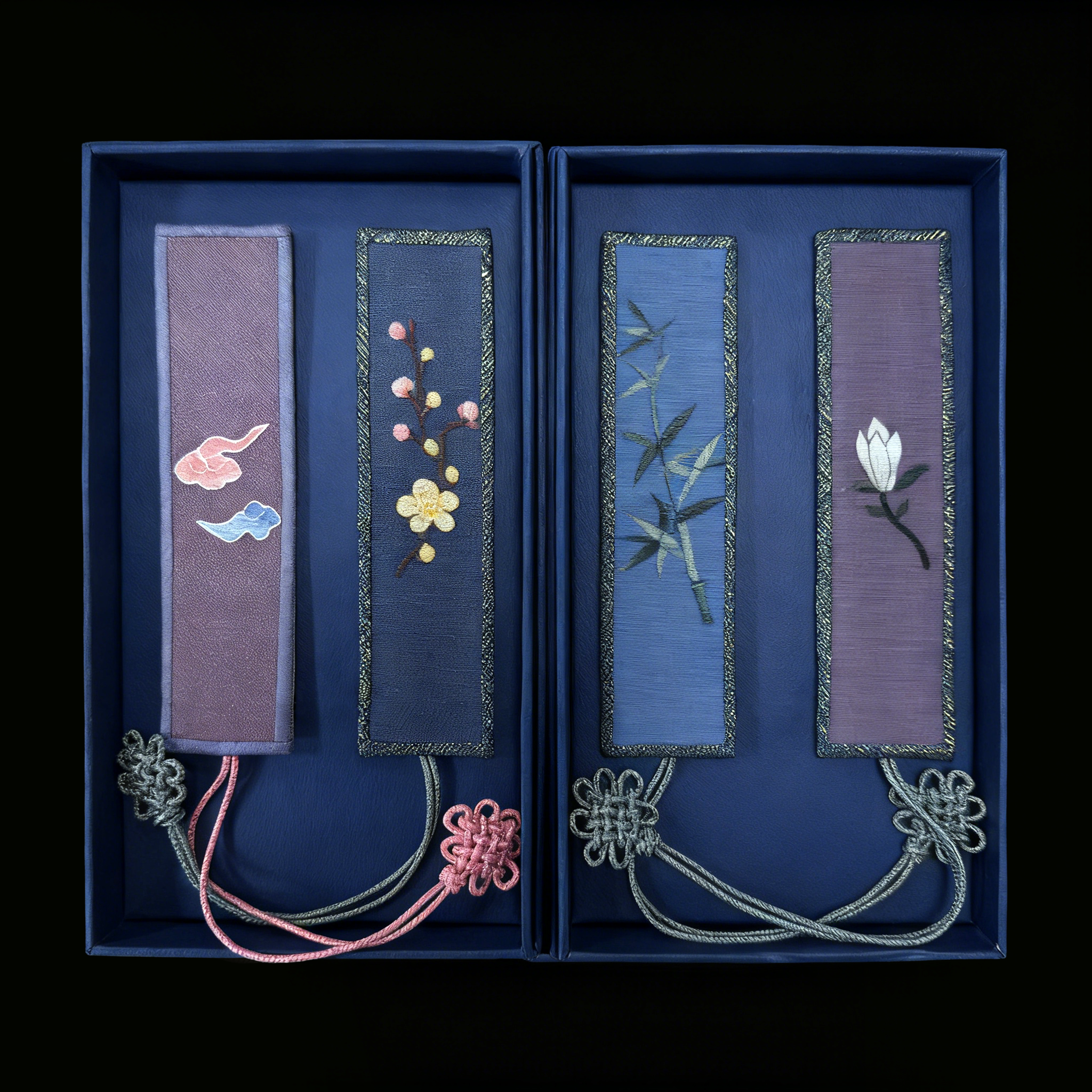
Regarded as one of the most ancient and refined forms of silk weaving in China, Kesi—which translates literally to “carved silk”—is celebrated for its intricate artistry and striking decorative appeal. This unique textile craft creates vivid, patterned motifs through a specialized interplay of warp and weft threads. The resulting fabric possesses a visual effect reminiscent of finely carved relief, with clear, outlined patterns and a rich, textured surface that is fully reversible. Unlike embroidery, which is worked atop a base cloth, or brocade, which is woven on a loom in a continuous manner, Kesi stands apart for its distinctive “cut-weft” weaving technique.
This historic art form has frequently been showcased in period television dramas, bringing its beauty to modern audiences. In the popular series Story of Yanxi Palace, the delicate Kesi fans wielded by imperial consorts conveyed an immediate sense of elegance and status. Likewise, the drama Marvelous Women, set against the backdrop of the Qing Dynasty, featured meticulously recreated scenes of Kesi production, offering viewers a glimpse into the painstaking process behind these luxurious textiles.

The Distinctive Nature of Kesi Weaving
The fundamental difference between Kesi and other renowned Chinese silks—such as Song brocade, Shu brocade, and cloud brocade—lies in its discontinuous weft technique. While brocades are formed by interweaving warp and weft threads across the full width of the fabric, Kesi uses a base of plain silk warp threads. The artisan then hand-weaves individual areas of colored, pre-dyed silk weft threads into the warp, only where a particular color is needed for the design. These weft threads do not run from selvedge to selvedge; instead, they are built up incrementally, and the weaver uses small shuttles to interlock them with the warp, creating the effect of a seamless, yet distinctly segmented, color palette. This “passing the warp and breaking the weft” method allows for incredible pictorial detail and sharpness of design, much like a tapestry.
With a history stretching back over two millennia, Kesi’s origins can be traced to the Tang Dynasty, with its golden age arriving during the Song Dynasty. From the Song and Yuan dynasties onward, it was officially designated as a fabric for the imperial household, used to create magnificent dragon robes for the emperor, formal attire for the empress, imperial portraits, and revered replicas of ancient paintings and calligraphic works. Because of the extraordinary skill and time required, Kesi reproductions of famous artworks were often considered even more valuable than the originals. Today, surviving antique Kesi pieces are exceptionally rare and are considered highlights in global auctions and museum collections of textile art.
A key characteristic of authentic Kesi is that it resists mechanization. Its creation depends entirely on the hand and eye of a master artisan. The process is incredibly slow—a highly skilled weaver may produce only about one to two inches of work per day. This labor-intensive nature demands not only technical skill but also profound patience, unwavering focus, and exceptional eyesight from the craftsman. Historically, this meant that Kesi was exclusively the province of the imperial court and nobility, a symbol of extreme luxury and refined taste.
A Six-Generation Lineage: The Wang Family of Suzhou
The story of Kesi’s preservation in the modern era is deeply intertwined with families who have dedicated generations to its practice. Master artisan Wang Jianjiang represents the sixth generation of a Suzhou-based Kesi family with a weaving legacy spanning more than a century. His ancestors specialized in producing the most formal and symbolic of garments: the dragon robes and court gowns for the Qing Dynasty imperial family. Family records indicate they were commissioned to create pieces for Empress Dowager Cixi herself, including an "Eight Immortals Celebrating Birthday Robe" and a "Xia Pei" (a type of ceremonial stole).
The family’s reputation for excellence was cemented in the early 20th century when Wang Jianjiang's great-grandfather, Wang Jinting, presented his masterpiece, Magu Presents Longevity, at the 1915 Panama-Pacific International Exposition in San Francisco, where it earned a prestigious award. This achievement brought international recognition to Chinese silk art. The legacy was continued by his grandfather, Wang Maoxian, who played an instrumental role in founding the Kesi Group at the Suzhou Embroidery Research Institute, an institution crucial to standardizing and preserving the craft.
Wang Jianjiang entered this world at the age of 17, when his father arranged for him to apprentice at the Wuxian Kesi General Factory. Despite being surrounded by Kesi from childhood, the young Wang initially felt resistance, daunted by the discipline and monotony of the loom. However, his father impressed upon him the profundity of their heritage, stating, “Kesi is embedded in the soul of our family; its inheritance is our mission.” These words ignited a sense of duty in Wang, compelling him to embrace the craft that would define his life.
Mastering Kesi is often described as "easy to begin, but a lifetime to perfect." The craft encompasses 16 distinct technical processes, and an apprentice typically requires three years of dedicated study to grasp the foundational skills. However, to create a piece of true artistic merit, a minimum of a decade of experience is often necessary. Even after more than 40 years at the loom, Wang Jianjiang speaks of Kesi with deep reverence. He admits that the deeper he delves into the art, the more he marvels at the skill of ancient masters, humbly believing that the technical prowess of modern weavers has yet to equal that of their predecessors.
The late 20th century posed severe challenges for the survival of Kesi. The 1970s and 80s saw a boom in exports, with demand outstripping supply. However, by the 1990s, the market had contracted dramatically, and many skilled practitioners were forced to abandon their looms for other professions. Through this downturn, Wang Jianjiang held fast. For him, the weight of six generations of continuous practice was not something to be abandoned. He viewed the preservation of the craft as a personal "merit," a cultural duty he was obligated to uphold, steadfast in his belief that a "glorious day" for Kesi would eventually return.
Preserving History: Kesi in Cultural Restoration
Wang Jianjiang’s expertise has found a vital application in the field of cultural heritage conservation. Since 2013, he has served as a long-term cultural relic restoration technician for the Palace Museum in Beijing. One of his most ambitious projects was the replication of the Ming Dynasty Wanli Emperor’s "Gun Fu," the most formal type of imperial ceremonial robe. This monumental undertaking consumed three years and required vast quantities of rare materials, including the feathers of 6,000 peacocks and over 100,000 meters of imported gold-wrapped thread, to accurately recreate the splendor of a 400-year-old imperial garment.
Another notable reproduction is the Kesi and Jade-Inlaid Bamboo Screen, displayed in the main hall of the Shoukang Palace within the Palace Museum complex. The central panel of this grand screen stands 120 centimeters high and 63 centimeters wide, flanked by two side screens measuring 100 by 36 centimeters each. The original artifact is a treasure from the Qing Dynasty. A significant challenge in this replication was matching the color palette, as the silk threads from the Qing period possess a unique luster and hue that modern threads cannot readily replicate. Wang spent months in preliminary research, meticulously analyzing the original’s color ratios and weft density. The actual weaving process then took a full year to complete, resulting in a reproduction that is both a scholarly achievement and a work of art in its own right.
The Contemporary Landscape and Future of Kesi
Today, the art of Kesi is at a crossroads. It has undergone centuries of innovation, refinement, and dissemination, yet its survival in the modern market economy is not guaranteed. In its heartland of Suzhou, many middle-aged artisans, who dedicated their youth to the craft, continue to navigate a difficult commercial environment, balancing artistic integrity with economic viability.
Despite these challenges, a resilient hope persists. A new generation of "Kesi craftsmen" is emerging. These younger artists and weavers are not only committed to mastering the traditional techniques passed down through families like the Wangs but are also exploring ways to inject contemporary relevance into the ancient art form. They are experimenting with modern designs, collaborating with contemporary artists and fashion designers, and leveraging digital platforms to reach new audiences.
Their persistence is breathing new vitality into Chinese Kesi, ensuring that this sublime craft does not remain a frozen relic of the past but continues to evolve. Through their hands, Kesi is being woven into a new, splendid chapter in the history of Chinese contemporary arts and crafts, honoring its imperial past while being thoughtfully adapted for the future. The thread, passed down over 2,500 years, continues to be woven, connecting the hands of today’s artisans with those of the ancient masters.
Share:
Latest Post


Ask For A Quick Quote
If you are looking for more information on our services, or how we could potentially help, we would love to hear from you!